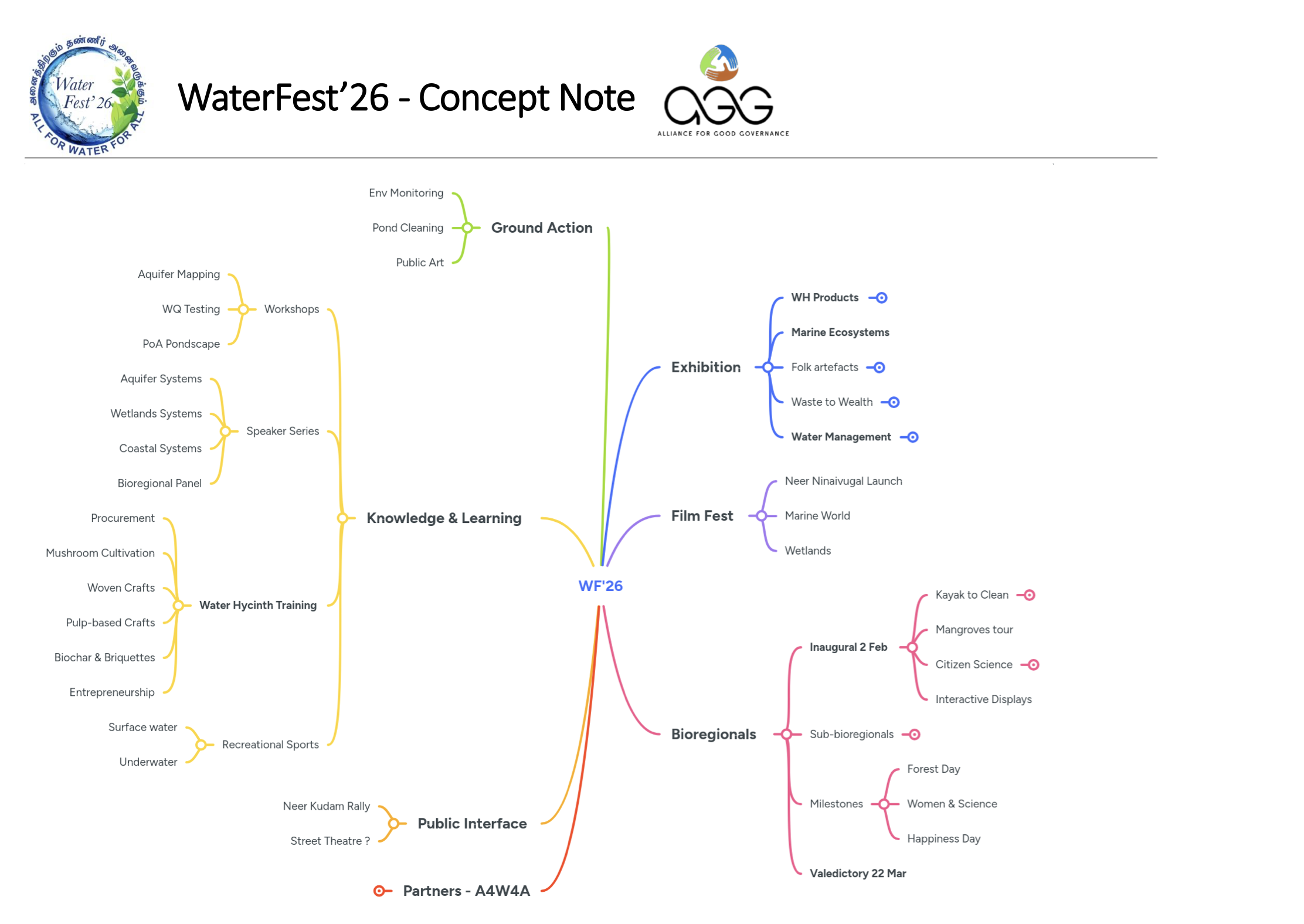
WaterFest’26 (WF’26) marks an important milestone as the festival enters its 10th anniversary phase, gradually evolving from an annual awareness event into a more sustained, bioregional platform for water stewardship. Rooted in Puducherry bioregion’s landscapes and communities, WF’26 carries forward a decade of learning, partnerships, and on-ground practice, while opening pathways for deeper and longer-term engagement with water systems and governance.
Anchored between World Wetlands Day (2 February) and World Water Day (22 March), WaterFest’26 is conceived as a living journey across the region’s waters - from ponds, tanks, and groundwater, through wetlands and estuaries, to mangroves and the sea. Rather than treating these as isolated sites, WF’26 foregrounds their ecological and social interconnections, and the shared responsibility of caring for them as a continuum.
The festival is guided by an integrative framework of learning, grounded action, culture, exhibitions, and livelihoods. Orientations and workshops introduce participants to wetlands, biodiversity, aquifers, and coastal systems. Hands-on activities - such as field demonstrations, clean-ups, and environmental monitoring - translate knowledge into practice. Exhibitions and interactive displays help make science, data, and ecological processes visible, tangible, and accessible to wider publics.
The inaugural program on 2 February 2026, to be held at Thengaithittu, is conceived as a preview and invitation to the wider WaterFest’26 journey. Set within an estuarine and mangrove landscape, the day offers a glimpse of what is to come: interactive displays on wetlands and estuaries; citizen science engagement using tools such as iNaturalist and water-testing kits; youth-focused activities including kayak-based clean- ups and guided mangrove tours; and marine science experiences such as plankton observation, demonstrations of research equipment, immersive learning modules, and short films on water and marine ecosystems. Early showcases of livelihoods, circular economy practices, and regeneration narratives point towards the deeper work that will unfold over the festival period. Set in Bahour, a central pillar of WF’26 is a 45-day integrated training on water hyacinth–based livelihoods and circular economy practices, moving well beyond episodic clean-ups. The program reframes aquatic weeds from “waste” to ecological resource, enabling women’s groups and local communities to engage in a diverse range of applications - woven handicrafts, handmade paper and papier-mâché toys, mushroom cultivation, and value-added bio-products. At the landscape scale, harvested biomass is channelled through composting and biochar for soil improvement, and biogas for clean energy, linking livelihoods with regenerative land, energy, and water management.
Together, these practices support pond-scape regeneration through regular biomass removal, improved water quality, and shared stewardship of common water bodies. Water hyacinth thus emerges as a sentinel material for climate action - sequestering carbon, improving soils, enhancing energy efficiency, and reducing methane emissions from unmanaged decomposition - demonstrating how local circular economies can meaningfully contribute to climate mitigation and water conservation.
In parallel, WF’26 foregrounds household-scale water responsibility, with learning and demonstrations around rainwater harvesting and greywater treatment, pointing towards a future where every home can become an active participant in water conservation and groundwater recharge.
As WaterFest’26 unfolds across the bioregion, activities extend inland through workshops, field visits, public art, film screenings, and youth engagement programs. Open to the general public, with a special focus on school students, college youth, community groups, and women’s collectives, WF’26 aspires to move beyond awareness, towards sustained care, collective action, and long-term transformation in how water is understood, managed, and lived with in the Puducherry bioregion.